Does your Brand need Brand Guidelines (Brand Book)

Does your Brand need Brand Guidelines (Brand Book)

brand guidelines

You’ve thought of an amazing brand name, come up with a spectacular logo, you’ve paid top dollar and built a gorgeous website. Every piece of material that goes out of your company is meticulously detailed. But people still don’t seem to remember your company name, or what your company sells, or even what your logo looks like. Have you ever wondered why that is?

The answer is simple. Your branding lacks consistency and direction.

Your Brand is more than just a name or a logo or a website. It is an experience.

And you can (to a certain degree) craft this experience for your target audience. How?

By Means of a Brand Guidelines (Brand Book)

What are Brand Guidelines?

A Brand Guideline (also referred to as a ‘brand book‘ or  ‘brand style guide‘) is a set of rules that details how your brand works and how your brand should be represented. These guidelines include the Identity elements and Visual elements of your brand.

The Brand Identity Elements are:

  1. Your Brand Story
  2. Your Brand Philosophy (Mission, Vision, and Values)
  3. Your Brand Personality / Brand Voice
  4. Boilerplate etc.


The Brand Visual Elements include:

  1. Logo and tagline
  2. Proper and Improper usage of Logo and Tagline (With visual examples)
  3. Your colour palette
  4. Your typography
  5. Stationary / Merchandise design
  6. Brand Do’s and Don’t’s etc.    

Does your Brand need Brand Guidelines?

The Short Answer is YES. Here’s why:


01

Ensures Continuity

Your brand is bound to be represented by more than one person/agency.  Your Brand guidelines ensure that whoever is representing your brand, follows a set of rules and regulations so that the target audience is familiar with the voice and image of the brand.

Picture1
Picture3

02

Ensures Correct Usage

Stretched Logos, mixed up colours, terrible backgrounds, blurry images, these are a brand custodians worst nightmare. And this is precisely what will be avoided with a clear, specific and concise listing of how to use a brands marks.

03

Avoids Confusion

Multiple people represent a brand,  using brand guidelines ensures that anyone who represents your brand is familiar with the messaging, look and feel of the brand. This way, the target audience will always receive an undeviating constant communique.


Picture2
Picture4

04

Sets Standards

A brand guideline clearly specifies the colour palette, font types/font combinations, background colour, logo usage etc. So all your collaterals will be consistent, the brand recall will be optimum.

05

Increases Brand Recall

Consistency will aid people in remembering your company name, the logo, what your company sells etc. It firmly plants the brand in the audience’s mind, and how it is perceived will be in your hands.


Picture5

Making your brand identity clear will go a long way in how people perceive your brand and how it’s short term and long term brand image shapes up.

Brand Guidelines is the difference between your brand being a bus headed nowhere and a bus headed to a destination.


Contact us to create a guideline for your brand today.

8 Simple Tips on How to Write Good Blog Titles

8 Simple Tips on How to Write Good Blog Titles

8 tips to write blog
  • How do I write good blog titles?

  • Do questions make good blog titles?

  • Are my blog titles too boring?

  • SEO vs. Creativity?

Every writer/blogger is faced with these questions. In a world where your blog titles are the difference between your readers skipping your blog or clicking the link to revel in your infinite wisdom, mastering the art of writing good blog titles is imperative.

Are good blog titles important?

On the average, five times as many people read the headline as read the body copy. When you have written your headline, you have spent 80 cents out of your dollar. – David Ogilvy


  1. Titles are the first things that show up in search results. 9 out of 10 times, they decide if the reader clicks your blog link.
  2.  They can engage your customer to within a few moments.
  3. Search Engines determine what your website is about from your page titles.
  4. They hugely contribute to your SEO, thereby making your blog more findable.


Here are my

8 Simple Tips on How to Write Good Blog Titles

Tip #01

Make Sure it's Relevant.

Your title is a promise to the reader. They click your blog title link hoping to find useful information. Your title should accurately describe what the reader will find in the body of the blog. The meta description should support the blog title. Do not mislead. Do not annoy.

With regard to SEO, an unhappy reader will hit the ‘Back’ button and up your bounce rate, thereby reducing your website ranking.

Tip #02

Be Creative. Be Original.

A unique title will present the reader with a pleasant surprise in an otherwise boring list of titles in his search results. It is an easy way to stand out and grab the reader’s attention. Your blog titles should ideally be a balance between creativity and SEO.

Tip #03

Brevity - Keep it short. Keep it simple.

Your blog title should typically be between 6-8 words, an ideal title can be read with just a single glance. When you share your content on social networks or when it appears in the search results, your readers should find the entire title instead of half cut words.

Tip #04

Include Keywords - Optimize for Search and Social Media

Creativity is for the human readers to click the blog title, keywords are what will help search engines know what’s in your blog. Keywords also help the reader know the subject of the blog.
Make sure you keep just 1-2 keywords.

You can use the formula

<Number> – <tips/tricks> – to – <adjective> – <promise> – <keywords>

An example would be

8 – Simple Tips -on How  to – Write –  a Good – Blog Titles

Tip #05

Intrigue the Reader - pose a question.

Questions make great blog titles. They introduce the element of curiosity. Suggest to the reader that there is something to look forward to after clicking the title.


Tip #06

DO NOT COPY SOMEONE ELSE'S TITLE.

The internet is filled with hundreds of similar titles, always perform a search before you freeze a title. If there’s already an article named ‘Marketing Tips’, you should probably reconsider the title or change the order of the words to ‘7 Simple Tips for Successful Marketing’.

This Improves your ranking and also makes you distinguishable.

Tip #07

Make sure you answer the 'Why' or 'So what' question.

Always address the question ‘Why’. Why should a reader read your blog? Why is it more preferred than someone else’s blog?  For example, this blog could have been named ‘Guide to writing blog titles‘, But that does not answer the question Why should I read it?

Examining the name ‘8 Simple Tips on How to Write Good Blog Titles’, 
Why should I read it? So I can Write Good Blog Titles.

Tip #08

Write at least 3 versions of your headline.

You might not always have the best version on your first attempt. I generally write 3 version of my title, listen to myself say the 3 titles and choose the one I would click among the 3. If you’re not sure which one you’d click, use the process of elimination and remove the ones you wouldn’t click until you’re left with 1 title.


Please let us know what you think of our blog title tips. I’m sure you might have a few tips of your own, please feel free to share them in the comments section.

5 Copywriting Tips for Creating Interesting Social Media Posts

5 Copywriting Tips for Creating Interesting Social Media Posts

3 cs of copywriting

Copywriting requires a combination of 3 skill sets – storytelling, conciseness, and creativity. In a world where people don’t pay more than a few seconds of attention.

Brevity is the soul of wit – William Shakespeare

keeping your social media posts short, sweet and to the point is of paramount importance. Here are the 5 Copywriting Tips for Interesting Social Media Posts:

01

The 3 C’s of copywriting

The number 3, symbolizing trinity, the minimum number of sides required to form a closed shape, symbolizes completeness. So it would only make sense that the rules for copywriting would come in 3’s.

So here are the 3 C’s of copywriting:

  1. Clear
  2. Concise
  3. Compelling

Your social media posts need to be clear, to the point and interesting enough to invoke an action.

c
u

02

The 3 U’s of copywriting

    1. Unique
    2. Useful
    3. Urgent

    Your writing needs to create a sense of urgency so it encourages the viewers to act.

    03

    The 3 W’s of copywriting - Who? Why? What?

    Copywriting is similar to storytelling, therefore an effective method that can be incorporated is the 3 W’s, which is the condensed version of Who? Why? When? What? Where? How?

    1. Who is this for?
    2. Why should someone care?
    3. What should be done next?

    Answer these questions so it stays relevant to the reader and there is purpose, personalization, and direction for the reader.


    w
    social proof1

    04

    Use Social Proof - Substantiate your claim

    There is little trust on the internet. People make a lot of claims. A LOT!

    There are a lot of fraudulent posts online, this makes users sceptical to the claims made online. If you have relevant information to back your claims, it might be a good idea to use social proof in your posts to increase the trust factor.

    An easy way is to link the person you are referencing (ideally an influencer with a following) or show proof in the form of imagery.

    People are far more relieved and more likely to act when they know someone else has walked the same path with desired results.

    05

    AIDA

    AIDA is an old-school marketing technique and can be used effectively in copywriting as well. example.

    AIDA stands for:

    1. Awareness
    2. Interest
    3. Desire
    4. Action

    It is the act of moving someone from the state of being Unaware about a certain topic to a state where they perform a desired action, like purchasing your product or service.

    A person might spend 10 seconds or less on your post title, make sure there is something that grabs their attention right off the bat. Interesting imagery or content could grab their attention – social proof is a good method to move your prospects from awareness to desire. Action is a matter of good lead follow-up processes.


    aida
    The World Runs on Word of Mouth

    The World Runs on Word of Mouth

    word of mouth

    About 3 years ago my friend started telling me about this new motorcycle (KTM Duke) that was coming into our country pretty soon. At first I didn’t read much into it, but after a little while I was curious so I started checking it out and took it for a test ride and the next thing I know I was walking out of the showroom with the keys to my new bike. I know for a fact that I have done more than my fair share of Word of Mouth marketing for my motorcycle’s manufacturer without them even prompting me to do so or even knowing about it.

    Word of mouth is one of the oldest, simplest and most effective means of marketing communicationTweet that. It requires little more than the physical presence of two or more like-minded people.

    01

    Why is word of mouth important?

    Word of mouth is an easy way for your customers to be positive about your product or service. If you think about how the majority of people make their purchases it’s usually because of a recommendation from a friend or family member.

    02

    Is word of mouth effective?

    Any customer who is satisfied with your services or products is going to tell their friends and family members about it. They are likely to try it out for themselves and if they are pleased will, in turn, tell other people about it. It’s a little like a chain reaction.

    03

    My company and its products/services might simply not come up in conversations between people, what then?

    Word of mouth marketing is not restricted to solely oral communication. As all good things do it has evolved to be used across various platforms and modes of communication and mass media. There are, for example, entire channels on video streaming platforms dedicated to trying out products and reviewing them. In some cases even blatantly promoting said product/s.

    04

    Alright, I’m convinced that it’s viable, but how do I get into the domain of word of mouth marketing?

    To begin with, make sure that you are giving your customers a quality experience/product. Consumers that are happy with their purchases and or experiences are almost certain to want to tell people about it. The promotion aspect takes care of itself in a few ways. Think back to when you were a kid and you bought a toy and you really enjoyed it. The first thing you wanted to do was tell your friends about it.

    05

    Will it help my company get the recognition that big ad campaigns offer?

    Word of mouth has a way of being very cost effective, in that you don’t have to pay people to do it – Tweet that. Big ad campaigns take a large amount of capital and are not always effective and in some rare cases can even backfire. The only immediate downside to word of mouth marketing is that one customer or a user may have a bad experience and may offer bad reviews or negative word of mouth. This is fixed if the issue or problem that customer faced is addressed in earnest.

    A customer talking about their experience with you is worth ten times that which you write or say about yourself.”                                          ― David J. Greer

    Fractional CMO – Less is More

    Fractional CMO – Less is More

    fractional cmo

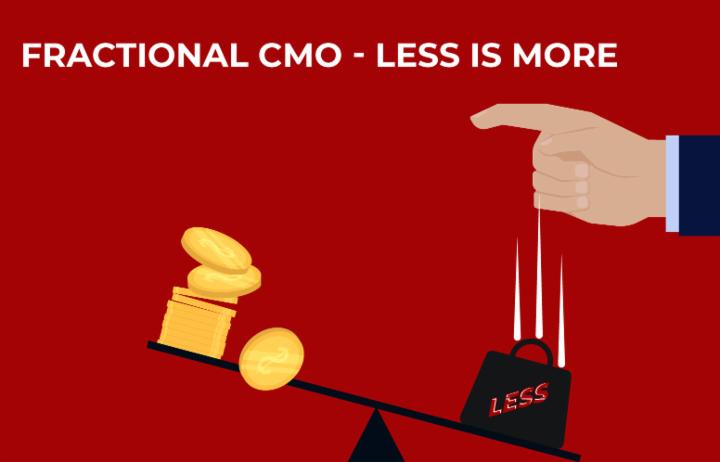
    Fractional CMO’s – what they do, why they matter and what advantages your business can reap from having one in your organization.
    For the uninitiated, let’s start by understanding what a CMO does and why businesses need them.
    A CMO is a Chief Marketing Officer and they have a vast array of strategic services to offer. They can monitor and create everything from branding and positioning tactics, up to ensuring the viability of marketing investments and making sure that there will be visibility and brand awareness. Now most businesses that have been around for a while will have a full-time CMO, the “right-hand man” of the CEO.

    CMO’s help increases qualified lead flow, co-create and support integrated sales and marketing processes, and help shorten the sales cycle by identifying and removing possible friction in customer acquisition efforts. So it is established that CMO’s are vital to any organization, especially for SMB’s considering how important brand positioning, marketing, sales and support are for an up and coming organization.

    However, a seasoned CMO can be expensive and might cost well beyond the limited budget of an SMB. Most startups and SMB’s do not have the kind of budgets and service requirements that a CMO can work with full time. Not every startup can afford a veteran who has truckloads of experience and insight on how things should be run. So how is a small business or startup that wants the expertise and experience of a seasoned CMO supposed to afford one?

    Introducing the concept of a Fractional CMO. Fractional CMO’s can offer their services on a part-time or task-to-task basis. SMB’s and startups can now acquire the services of an experienced CMO without having to bear the brunt of the price tag that comes with a full-time CMO. A fractional CMO can help you increase qualified lead flow, build integrated sales and marketing processes, and win business faster.

    To sum it up, a fractional CMO can help your organisation:

    01

    Save Money

    Will not cost as much as a full-time CMO.

    02

    Bring in Best Practices

    It will identify and fix gaps in the marketing plan and help create a rich pipeline of prospects.

    save money1

    03

    Bring in Knowledge and focus

    Consistent, relevant & targeted efforts on offline and online mediums in the right mix will get you better results.


    In most small businesses the CEO also takes the ownership of marketing and due to stretched schedules, marketing takes a back seat. Having a fractional CMO will ensure consistency and focus, which will bring in best results.

    However it is important to understand that CMO’s are not one man miracle workers, they will work with your marketing team, directing their efforts to get things done.

    bring knowledge n focus